Warm-Up:
There is a clamp tied to the ceiling with a string. There is an identical string hanging from the clamp. I am going to pull on the bottom string until one of the two strings breaks. Which string is going to break first? Why?
Today:
- Return Tests and discuss answers. If you are thinking about retaking the test, watch this video of me going over the test, and study!
- Begin Newton's Laws
- Design a rubber band-powered car. Limitations: Maximum rubber band force (when fully stretched) = 50N. Car must fit in a box no larger than 50cm x 20cm x 20cm. Goal = maximum top speed. For an A, your car must have a maximum velocity of at least 2m/s, and it must travel at least 10m.
- Provided materials: wood (white pine, approximately 30cm x 1cm x 2cm), hot glue, four rubber bands, nails, wire, cable ties, string, cardboard, various tools
- Draw a car design and make a materials list....
- You must make two drawings
- Each drawing must be from a different perspective.
- Each drawing must fill most of 1/2 of a normal sheet of paper.
- Each part must be labeled with the materials you plan to use to create that part.
Homework:
- Gather rubber band car materials
Warm-Up:
How can you pull a piece of paper out from under my pen -- without making the pen fall? Why does this work?
Today:
- Test
- Begin new unit -- Newton's laws
- design a rubber band powered car?
Homework:
Absent Students:
.JPG) Warm-Up:
The graph on the right shows the positions at different times for seven
different people. Which person (or people)
is (are)...
Warm-Up:
The graph on the right shows the positions at different times for seven
different people. Which person (or people)
is (are)...
- moving at a constant speed?
- moving backward?
- not moving at all?
- accelerating?
- decelerating?
- accelerating the fastest?
- moving at the fastest constant speed?
Today:
- Check Homework (Unit 1 review through #35)
- Finish Unit 1 Review. Watch these videos of us going over the review. Part IV includes a few extra problems. Videos: Part I, Part II, Part III, Part IV
- Study some. Then get quizzed.
- Test next class. Then begin Unit 2: Newton's Laws.
Homework:
- Study for test!
Absent Students: Study for test
Warm-Up: Assume that g = 10m/s/s
A bowling ball falls from the top of a building and hits the ground after 4 seconds. How tall is the building?
Today:
- How to turn in slideshows and LEAF paragraphs
- Begin Unit 1 Review.
- MythBusters Penny Drop Video (last 25 minutes)
Homework:
- Turn in slideshows and LEAF paragraphs by Tuesday
- Complete through number 35 of Unit 1 review
Absent Students:
Warm-Up:
LEAF is an acronym that can be used to remember the important parts of a well-written paragraph. What do the letters stand for?
L = ___________________
E = ___________________
A = ___________________
F = ___________________
Today:
- Finish your slideshow. View your slideshow as a slideshow (click the slideshow menu at the top of the page, and choose "view slideshow"). If it looks right, hooray! If weird things happen to your graph, get Mr. Stapleton's help.
- Save your file in your folder. You will need it in the future! Make sure your name is in the title of the file (e.g. "Frederick Smith Rocket Slideshow").
- Click the PDF icon at the top of the slideshow page and export your slideshow as a PDF. Turn this PDF in to M:Stapleton; Drop; Physics; Rocket Flight Slideshows; Your Class.
- Write LEAF paragraph in response to the following question. What is the most important thing that you have done so far in this class? To turn this in, your options are: A) type this and turn it in to Mr. Stapleton's drop folder on the M:drive B) type it; print it out; and turn it in to the in-box in E205 C) write it out, by hand, in blue or black ink, and turn it in to the in-box in E205. Click here to see the assessment rubric.
Homework:
Slideshows and LEAF paragraphs are due by next class.
Coming Up:
Test review on Thursday.
Absent Students:
- Complete the warm-up, above
- Complete slideshow and LEAF paragraph (see above)
Warm-Up:
A car slowed to a stop over a distance of 24 meters and a time of 4 seconds...
- What was its average velocity?
- What was its starting velocity (when it began to slow down)?
- Was its acceleration?
Today:
- Return Homework
- Work on library computers: initial and final velocities and accelerations of rockets.
- Complete rocket analysis. You will need to do this on a school computer. Here are the directions.
Homework:
Absent Students:
- Complete the warm-up, above.
- Finish rocket analysis on a school computer. Here are the directions.
Warm-Up:
Determine your height in meters. Write it down.
Today:
- Turn-in homework.
- Work on library computers: initial and final velocities and accelerations of rockets.
- Complete rocket analysis. You will need to do this on a school computer. Here are the directions.
Homework:
Absent Students:
- Complete the warm-up, above.
- Complete the rocket analysis on a school computer. Here are the directions.
Warm-Up:
A ball is thrown directly upward with an initial velocity of 30m/s. How high does the ball go before it falls back down?
- How long will the ball continue to go upward?
- How long will the ball stay in the air?
- What is the ball's average velocity on its way up?
- How high does the ball go?
Today:
- Continue in acceleration packet. Here's the video from class.
- Measure the acceleration of a fan cart.
Homework: Velocity and acceleration practice questions (p 14-16 of acceleration handout) due next class.
Absent Students:
- Complete the warm-up, above.
- Watch video and complete acceleration packet.
- Complete homework (see assignment, above)
Warm-Up:
 A runner was standing still on a starting line.
Once the race
started, the runner had an acceleration of 2m/s/s. The runner ran
for 5 seconds.
A runner was standing still on a starting line.
Once the race
started, the runner had an acceleration of 2m/s/s. The runner ran
for 5 seconds.
- What was the runner's initial velocity (at a time of 0 seconds)?
- What was the runner's final velocity (after five seconds)?
- What was the runner's average velocity?
- How far did the runner run during those 5 seconds?
Final Rocket Standings:
| Rank | Prize | Group Members | Block | Longest Time (s) |
| 1 | Large Pizza + 2% | Michael, Ferat, Jack | w3 | 46.1 |
| 2 | Medium Pizza + 1% | Abraham, Hamsa, Binti | w3 | 28.47 |
| 3 | 1% Extra Credit | Aaron, Molly | w3 | 21.28 |
| 4 | 1% Extra Credit | Madina, Holly, Mahalia | w1 | 20.1 |
| 5 | Marcel, Inidira | w2 | 13.7 | |
| 6 | Chris | w2 | 13.43 | |
| 7 | Brianna Christensen | w3 | 11.9 | |
| 8 | Aldin, Almedina, Matt | w2 | 10.56 | |
| 9 | Harrison | w2 | 9.6 | |
| 10 | Briaunna Croteau | w3 | 9.1 | |
| 11 | Zach, J.R. | w1 | 9.08 | |
| 12 | Dusty, Fidelia, Kayla | w2 | 8.7 | |
| 13 | Mariah, Rachel | w3 | 8.5 | |
| 14 | Long | w2 | 8.33 | |
| 15 | Matt P. | w3 | 8.3 | |
| 16 | Jake D, Erlon | w1 | 8.2 | |
| 17 | Courtney, Billy, (Bridget) | w1 | 7.6 | |
| 18 | Brandon | w3 | 7.4 | |
| 19 | Lucas, (??Jake V) | w1 | 7 | |
| 20 | Greg | w2 | 6.4 | |
| 21 | Codi | w3 | 5.7 | |
| 22 | Matt | w1 | 5.24 | |
| 23 | Tabitha, Ophelia, Dylan | w2 | 4.26 |
Today:
Continue Acceleration Notes. Learn how to use the acceleration formula. Here's the video from class.
- Fast Car Accelerations new "fastest" car new land speed record
- Mantis Shrimp Strike Acceleration (6,300-8,000 G) Mantis Shrimp Attack Video
- Flea Jumps - 140G
Absent Students:
- Complete the warm-up questions
- Watch this video and complete the Acceleration Notes
Warm-Up:
A rocket has a velocity of 30m/s. Two seconds later, the rocket's velocity is 22m/s. What is the rocket's acceleration?
Today:
- Measure rocket mass (without water)
- Measure rocket length
- Measure volume of water in rocket
- If you want to launch more than once, take extra water.
- Fill out rocket data sheet and take it with you to the launch site
- Launch rockets and collect video data
- If you want to know your time, time your rocket yourself. Official times will be taken from video footage.
Launch Procedure: One group member should stand by the launcher before the launch -- and then back away during the countdown. The same group member should chase the rocket and, after the rocket hits the ground, stand next to the landing spot.
Absent Students:
- Complete the warm-up, above.
Physics (Stapleton) Open House
1) Website (and JupiterGrades)
2) Tentative Topics:
a) Motion: Velocity, Acceleration, Rockets
b) Newton’s Laws: Objects in motion… Mousetrap Cars
c) Rotational Motion and Machines: Catapults
d) Waves, Sound, and Optics: radar, rainbows…
e) Astronomy: stars, black holes…
f) Electricity and Magnetism: wiring
Warm-Up:
- A runner is standing still, at the beginning of a race. When the starting pistol is fired, the runner begins to run. After one second, the runner's velocity is 3m/s. What is the runner's acceleration?
- Another runner starts at the same time. After 2 seconds, this second runner is going 8m/s. What is this second runner's average acceleration?
- Half-way through the race a third runner has a velocity of 5m/s. Then, after one more second, that runner has a velocity of 7m/s. What is this third runner's acceleration?
- A fourth runner has a velocity of 7m/s. After two more seconds, this fourth runner has a velocity of 9m/s. What is the runner's acceleration?
Today:
- Block 1: Return Quiz
- All Blocks: Finish rockets. There will be very little work time next class. Launching will take longer, due to the rockets needing to be videoed.
Absent Students:
- Complete the warm-up, above.
- Get your rocket ready to go!
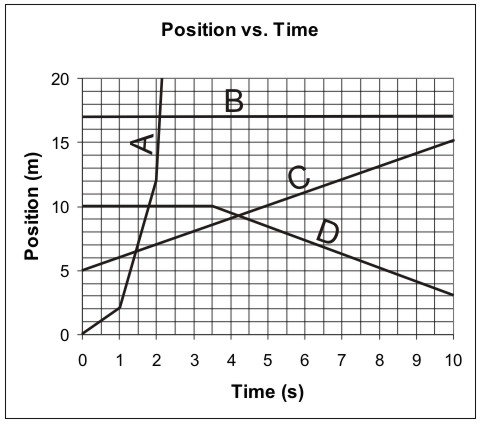 Warm-Up:
On the graph to the right...
Warm-Up:
On the graph to the right...
- Which object is decelerating?
- Which object is not moving at all?
- Which object has a constant speed?
- Which object is accelerating?
- What is the starting velocity of A?
Today:
- Block 1: Quiz
- Blocks 2-3: Return Quizzes
- All Blocks: Graphing review.
- Rocket work time
- Final Rocket Launch on Friday!
Absent Students:
- Complete the warm-up, above.
- Get the motion graph review. Then watch this video and check your answers.
Warm-Up:

2. Why?
Today:
- Quiz
- Velocity and Acceleration graphs. Here's a Youtube video explaining how to complete this activity.
Absent Students:
- Complete the warm-up.
- Watch the YouTube video, if you can. I couldn't upload it to SchoolTube.
Warm-Up:
What would happen if you made a hole through the center of the Earth, and you jumped in? If you came out the other side, where would you be? (antipodes map)

Today:
- Return papers.
- Work on rockets. Launch rockets.
Homework:
- ***Study for Quiz next class: Questions will be taken from pages 9 and 10 of your Acceleration Notes. If your notes are incomplete, print them out with the link above, and watch this acceleration notes video (from class).
Warm-Up:
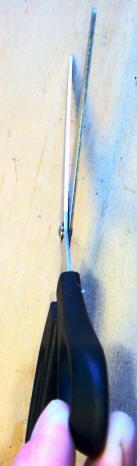
Explain how to cut with scissors. Why does it work? Specifically, suppose your friend is trying to cut through a thick piece of twisted plastic bag. Offer some suggestions regarding how to make the scissors work better. Explain why your suggestions will work.

Today:
- Acceleration Notes and graphing acceleration with fan carts. [Link to acceleration notes video]
- What went wrong with rockets? Fix them up.
Homework: None
Absent Students:
- Complete Warm-up.
- Get a copy of Acceleration Notes.
- Watch the acceleration notes video, above, and complete the acceleration notes packet up to the point where we stopped in the video.
Warm-Up:
What are the essential rocket elements that you need to complete so that your rocket will fly?
Today:
- Work on rockets
- Launch Rockets
Homework:
- No homework
Absent Students:
- Answer the warm-up, above.
Warm-Up:
Records of 132 cats that jumped from windows of buildings showed a 90% survival rate. The average drop was 5.5 floors.
Why do injuries increase from floors 1-6? Why would injuries decrease at over 7 floors?
Today:
- Quiz
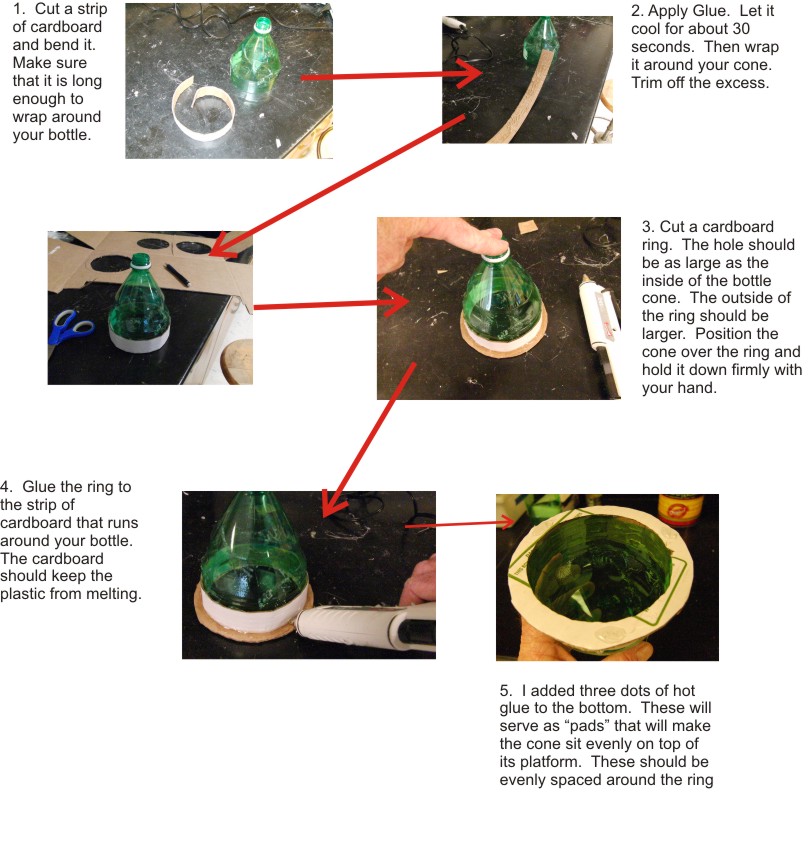
- Work on Rockets. The video link below shows how to make a parachute. However, I realized that the video does not show the simplest way to do it. When you are attaching the strings to the parachute, first put glue on the parachute, and then put the string in the glue. See the nosecone hints below. Video: attaching the parachute
- Click here to see tips on making your cone.
Homework:
- Get your rocket ready for launching next class.
Absent Students:
- Meet with Mr. Stapleton to arrange a quiz make-up.
- Read the warm-up above and the article link. Then answer the questions in red.
- Get your rocket ready for launching next class. For tips on adding a parachute and making your nose cone, see the links under "today," above. Write a note to Mr. Stapleton explaining what you did, and how much time you spent.
Warm-Up:
Estimate the average velocity of the pulley on a string.
Today: goal -- get ready for quiz
- Complete and/or review practice quiz. . Here is a video of the solutions.
- Make a plan for building bottle rockets, and begin work. Provided materials: duct tape, hot glue, scissors. You will need two bottles per group.
- This video (Rocket Instructions Part I) shows some one way to make a good rocket. Everything is good except for adding duct tape to the cardboard at the base of the cone. It's probably best to simply glue the cone to that cardboard. Parachutes get stuck to the duct tape.
Homework:
- Study for quiz next class. Study "measuring velocity" sheet and "meter stick units" sheet. It will be the same basic questions as the practice quiz . The specific numbers and some other details will change. You can study by watching the video of the quiz review.
Absent Students:
- Complete the "Homework", above.
- Study for quiz. Watch this video.
Physics: Mr. Stapleton
Warm Up Question:
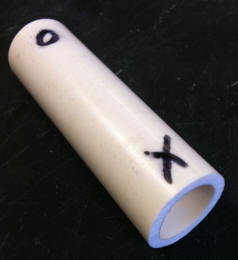 Spin
one of the "sprotating cylinders" by pressing one end until it squirts
out from under your finger. Try the other end.
Spin
one of the "sprotating cylinders" by pressing one end until it squirts
out from under your finger. Try the other end.
- What do you see?
- What happens when you walk down an escalator that is going up?
- What happens when you walk up an escalator that is going up?
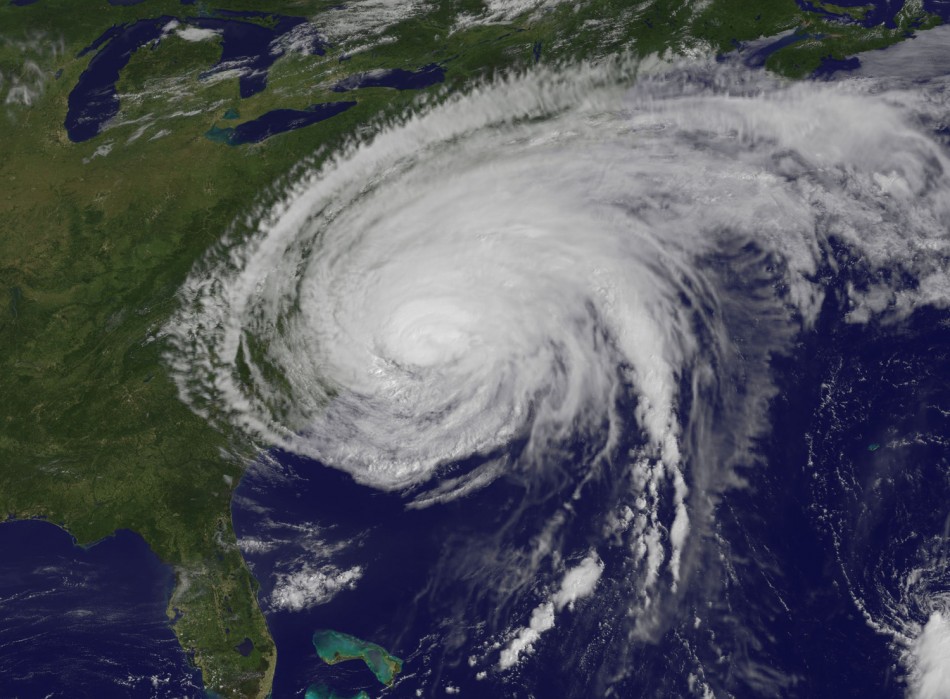
- Why were the winds slower on the west side of Hurricane Irene?
- When you spin the cylinder and see the "X," which symbol must be moving faster, the X or the O? Why is it moving faster?
Today:
- Learn names; fill out info sheets
- Go over course expectations
- Tidy
Homework:
- **Get parent signature on syllabus signed. Return by Tuesday, 9/13
- Begin collecting 2-liter soda bottles.
Absent Students:
- Answer the warm-up question, above.
- Begin collecting 2-liter soda bottles.